
Saint Francis by Trophime Bigot
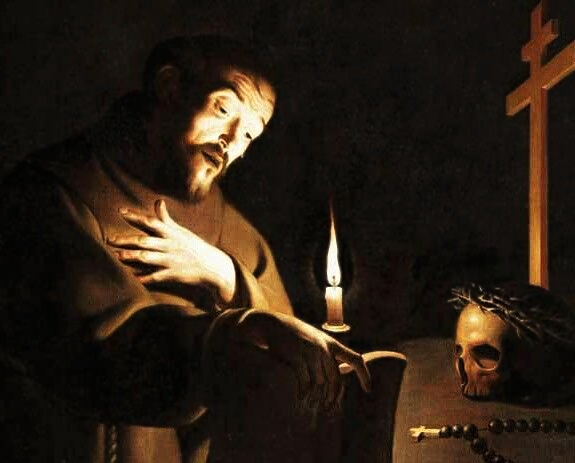
Saint Francis of Assisi in Prayer – Trophime Bigot (1630–1634)
For a long time, the author of a series of candlelit nocturnal scenes remained anonymous, known only as the “Master of Light.” Among these works is Saint Francis of Assisi in Prayer, now attributed to Trophime Bigot, who was born in Arles in 1579. After an initial training in his hometown, Bigot moved to Rome around 1620, where he was influenced by Caravaggio’s dramatic use of chiaroscuro. He returned to southern France in 1634, ultimately settling in Aix-en-Provence, producing works of vigorous realism and luminous effect that were highly sought after throughout Provence.
In this intimate nocturnal composition, Saint Francis is shown alone, seated or standing at a simple desk or table. A single candle serves as the central source of light, casting a warm, golden glow across his face, hands, and the modest objects nearby—a skull and a crucifix—while the surrounding space recedes into profound shadow. The saint wears the characteristic brown Franciscan habit, rendered with soft, realistic folds, and his slightly bowed head and hand placed over his chest convey a posture of deep humility, prayer, and self-surrender. Bigot’s attention to the flickering light and the subtle gradations on Francis’s features highlights both the physical and spiritual illumination, inviting the viewer into a contemplative space.
The background is intentionally nearly black, isolating the figure and enhancing the solemn, meditative atmosphere. The limited palette—dark browns, blacks, ochres, golds, and soft flesh tones—reinforces the focus on the saint and his devotion, in keeping with the Franciscan ideals of poverty, asceticism, and withdrawal from worldly splendor. The presence of the skull emphasizes mortality and spiritual reflection, while the crucifix reinforces his dedication to Christ. Through this masterful use of chiaroscuro and candlelit intimacy, Bigot captures not only the visual drama but the inner life of Saint Francis, making the painting both a devotional object and a study in spiritual serenity.


This image is a public domain image, which means either that copyright has expired in the image or the copyright holder has waived their copyright. Franciscan Gallery charges for the access to high resolution copy of the image. Manually restoration was necessary in order to improve quality, without covering the original image.

Comments
Post a Comment