
St Francis by Federico Barocci 1604
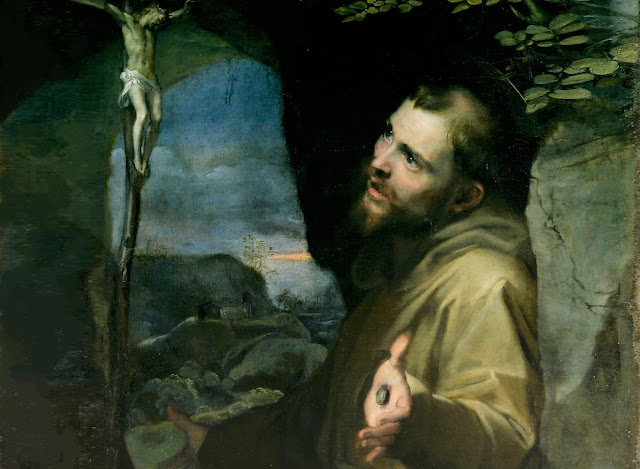
Federico Barocci – Saint Francis of Assisi (c. 1600–1604), Oil on canvas
Museum: The Metropolitan Museum of Art, New York.
The Metropolitan Museum of Art
+2
Iconografía Cristiana
+2
This beautifully detailed canvas represents Saint Francis in a state of deep meditation. Shrouded in the dim light of a grotto on Mount La Verna — the remote Tuscan site where he is said to have received the stigmata — Francis appears kneeling, holding the marks of Christ in his hands and feet. Barocci had a close relationship with the Capuchin order, and this particular work is believed to have been made for a friar associated with them.
The setting is both wild and sacred: the rough stone walls of the cavern, the shadowy opening toward the distant landscape, and the faint glow of divine light all contribute to a sense of mystical withdrawal. The saint’s brown habit is rendered with a softness and realism characteristic of Barocci’s late‑Mannerist/early‑Baroque style: subtle colour transitions, gentle modelling of flesh, and a contemplative expression that invites the viewer into his inward journey.
Although the composition retains a devotional austerity — no dramatic gestures or theatrical staging — Barocci’s use of realistic setting and emotive human presence mark this painting as fully within the Baroque era’s inward spirituality. His careful attention to light, texture, and psychological intimacy anticipate the Baroque’s emphasis on emotional engagement.
This work thus belongs in your Renaissance & Baroque chapter — a mature example of how Franciscan imagery evolved from symbolic medieval icons to deeply human, contemplative visions that speak to the heart. (Oil on canvas, 1604. Baroque art)

Comments
Post a Comment