
Delivery of Franciscan Rule by Colantonio 1445
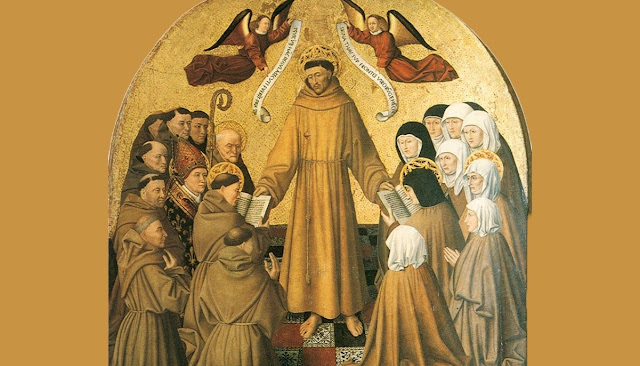
Saint Francis of Assisi (1182-1226), founder of the Franciscan Orders, delivers the rule, painting by Niccolò Antonio Colantonio (1445). National Museum of Capodimonte. Naples, Italy.
Colantonio operated in Naples from 1440 to 1460, under King René of Anjou and Alfonso V of Aragon, both great admirers of Flemish art. The diversity of these two influences—northern naturalism and Iberian precision—can be observed in two panels executed by Colantonio for the Franciscan church of San Lorenzo Maggiore. These were painted at different times and later completed by Antonello da Messina with smaller side panels depicting blessed Franciscans. The general theme of the altarpiece was the celebration of Franciscan thought, of which St. Jerome, according to the theories of St. Bernardino of Siena, had been considered one of the main intellectual influences.
In this scene, set against a radiant gilt background, a slender St. Francis stands at the center, consigning the Franciscan Rule to his brothers, who kneel reverently around him. At the left, Fra Leone receives the book, while on the right, a group of women includes St. Clare of Assisi. Above, two symmetrical flying birds hold cartouches, symbolizing divine approval of the Rule and spiritual harmony within creation. Continue reading after advertisement
Get 2 restored images (including the one featured in this post), now on sale

The work reveals Colantonio’s familiarity with the stylistic novelties brought from Aragon to Alfonso’s court. This influence is visible in the steep, almost vertical pavement, in the precise features of the figures, in the perforated halos, and in the rigid, geometric folds of their garments. These details highlight a moment of transition in Neapolitan painting, where late Gothic elegance meets the early Renaissance’s newfound structure and rationality, capturing the spiritual fervor and intellectual vitality of the Franciscan world. The other panel, depicting St. Jerome in His Study, despite being one or two years earlier, is still more influenced by the early Netherlandish painting in favour at the Angevine court, with painters such as Barthélemy d'Eyck.


Comments
Post a Comment