
St Francis embracing Christ at the Cross by Murillo 1668
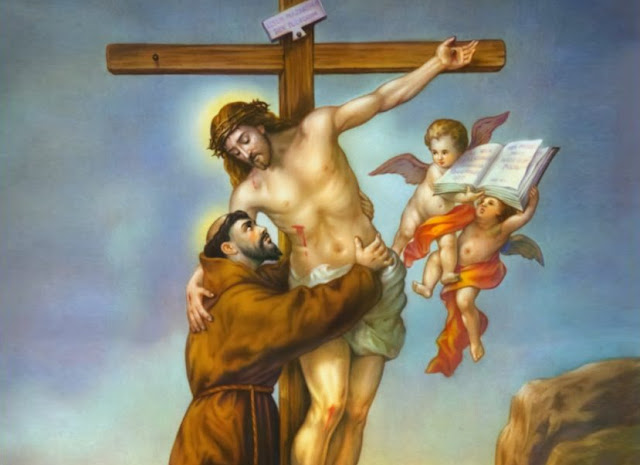
The painting is part of a series of paintings commissioned to Murillo by the Order of the Capuchins for the church of his convent in Seville. Such works, carried out around the years 1668 and 1669, were to exalt the distinctive elements of Franciscan spirituality.
The theme of the work (Allegory on the renunciation of the material world of Francis de Assisi to follow Jesus.) Had already been embodied by other painters and among all the versions, the most famous was that of Francisco Ribalta made about ten years before for the Capuchins of Valencia. Therefore it is easy to think that it was the Valencian brothers, who also contributed to the founding of the convent of Seville, who suggested to Murillo the reproduction of that motif in his web.
This composition captures the defining turning point in the life of Saint Francis of Assisi: the moment he renounces the world to belong entirely to Christ. The saint leans into the crucified Christ with deep tenderness, embracing Him as both Savior and Beloved. Christ responds with a reciprocal gesture, inclining His head toward Francis in a quiet and intimate acknowledgment of spiritual union. Here, devotion is rendered not as suffering or austerity, but as love. Continue reading after advertisement

Near the cross, two angels hold an open book displaying a passage from the Gospel of Luke (14:33): "So, then, any of you who does not give up all the things he possesses cannot be my disciple." The text functions not only as a scriptural reference but as the key to interpreting the entire scene. It visually translates Francis’ vow of absolute poverty, rooted in imitation of Christ.
At the base of the painting, Saint Francis places his foot upon a terrestrial globe. The gesture is gentle yet decisive: a symbolic act of renunciation. The material world is not despised, but relinquished. Francis steps away from earthly attachments to align his life completely with the divine.
Murillo’s palette is soft and warm, bathing the scene in golden browns, quiet greens, and subdued blues. These tones soften the drama, emphasizing instead tenderness, contemplation, and the interior luminosity of grace. The pale body of Christ contrasts subtly with the warmer tones of Francis’ humble habit, further highlighting the exchange of love between them. This is not a narrative of tragedy, but of union — a mystical embrace where human longing meets divine compassion.

This image is a public domain image, which means either that copyright has expired in the image or the copyright holder has waived their copyright. Franciscan Gallery charges for the access to high resolution copy of the image. Manually restoration was necessary in order to improve quality, without covering the original image.

Comments
Post a Comment