
Vision of Saint Anthony by Pittoni
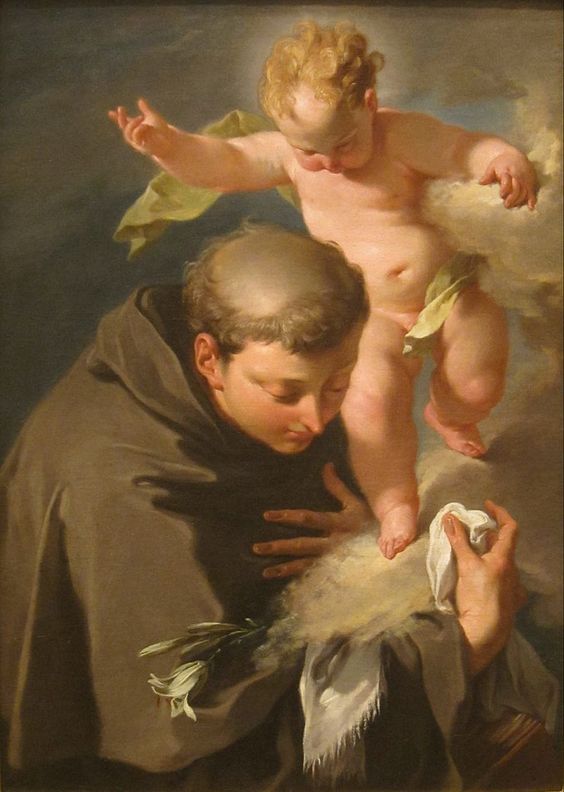
Giovanni Battista Pittoni, Italy (Venice) 1687-1767. oil on canvas, late 1730s
Giovanni Battista Pittoni was a leading figure in the Venetian Rococo, renowned for spreading the international success of this elegant and decorative style. Most of his religious, mythological, and historical works were commissioned by German, Polish, and Russian patrons. He trained initially with his uncle, the Venetian painter Francesco Pittoni, and joined the Venetian painters’ guild in 1716. In the 1720s and 1730s, his fluid, energetic brushwork produced vibrant Rococo paintings that reveal influences from Sebastiano Ricci and Tiepolo. A sophisticated colorist, Pittoni imbued his pictures with an Arcadian mood akin to the French Rococo. Later in his career, his palette lightened, and his compositions became more restrained, reflecting the rising influence of Neoclassicism. Highly regarded by contemporaries, Pittoni was a founding member of the Venetian Academy and succeeded Tiepolo as its president in 1758.
In this painting, Saint Anthony is depicted in a moment of divine revelation, kneeling and gazing upward as a celestial vision appears before him. The composition conveys a sense of ethereal grandeur, with soft, diffused light illuminating the saint and emphasizing his spiritual rapture. The arrangement of angels, clouds, and heavenly light creates a dynamic diagonal movement, drawing the viewer’s eye toward the miraculous apparition. Pittoni’s mastery of color is evident in the warm tones of the saint’s habit contrasted with the cool, luminous blues and whites of the heavenly figures, enhancing the painting’s emotional and spiritual impact.
The work exemplifies Pittoni’s ability to combine Rococo elegance with religious devotion, balancing decorative sophistication with narrative clarity. The painting’s refined gestures, delicate modeling, and atmospheric depth make it a distinguished example of Venetian Rococo sacred art, capturing both the personal mysticism of Saint Anthony and the broader grandeur of heavenly vision.
"Anthony of Padua was born in Portugal in 1195 and taught and preached in France and Italy. He was canonized in 1232, only one year after his death. His name is invoked to aid in the finding of lost objects. He is the patron saint of the poor and his attributes are the lily and the infant Jesus."
San Diego Museum of Art, California

Comments
Post a Comment