
Confirmation of the Franciscan Rule by Ghirlandaio 1485
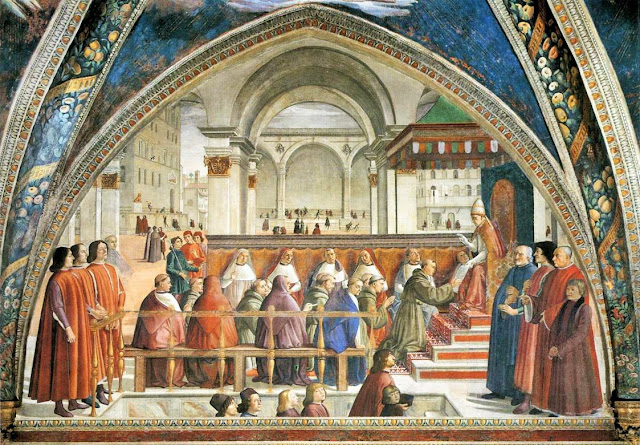
The Approval of the Franciscan Rule
Domenico Ghirlandaio, 1483–1486
Fresco, Cappella Sassetti, Santa Trinità, Florence
This fresco depicts the moment when Saint Francis traveled to Rome in 1209 to request approval for his newly formed brotherhood. Historically, this event took place at the Lateran Palace, before Pope Innocent III, but Ghirlandaio relocates the scene entirely to Florence, inserting his own city into Franciscan history. This blending of eras and places was intentional, expressing how Florence saw itself as continuing the spiritual mission of the saint.
At the center of the composition, Saint Francis kneels humbly as the Pope extends his blessing, approving the Rule of the Order. The figures surrounding them are richly dressed in Renaissance garments, and the setting is adorned with gold brocades, pearl details, and elaborate architectural ornamentation. Rather than presenting a medieval moment in its original simplicity, Ghirlandaio elevates the scene to the grandeur of a Florentine court.
A remarkable feature of the fresco is the presence of contemporary Florentine figures, including members of the powerful Medici family, inserted among the witnesses. Lorenzo de’ Medici can be identified on the right side, calmly observing the event. In the lower section of the fresco, Ghirlandaio includes recognizable landmarks of Florence such as the Loggia dei Lanzi, the façade of the Palazzo Vecchio, and the Marzocco, the heraldic lion symbol of the city. These urban references ground the mystical vision of Francis in the civic identity of Florence, celebrating both religious devotion and political pride.
The result is a vibrant, carefully composed work, rich in color and detail, that unites spirituality, civic prestige, and the memory of Saint Francis in one harmonious image.


Comments
Post a Comment