
Virgin and Child Appearing to Saint Francis 1599
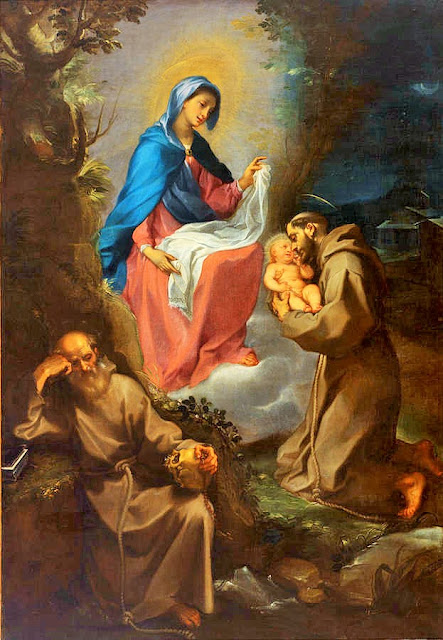
Virgin and Child Appearing to Saint Francis of Assisi. Francesco Vanni (1563–1610). Oil on canvas, 1599
This painting by Francesco Vanni, a leading Sienese artist of the late sixteenth century, depicts the Virgin Mary’s miraculous appearance to Saint Francis of Assisi. Rather than presenting the Nativity as a historical moment in Bethlehem, Vanni shows a vision — a moment of divine encounter that unfolds in a contemplative and interior spiritual space. The Virgin is seated, holding the Christ Child on her lap. The Child leans forward toward Francis, who kneels before them with arms open and eyes lifted in reverent wonder. His gesture conveys both longing and devotion, as though drawn irresistibly toward the living presence of Christ.
This painting by Francesco Vanni, dated 1599, depicts the Virgin and Child appearing to Saint Francis of Assisi, capturing a moment of divine visitation rather than the more usual Nativity scene or crib scenario. In the composition Francis kneels in adoration, the Child is held tenderly by the Virgin, and tertiary elements such as a skull (symbol of the fragility and passing of earthly life) appear alongside him. Another friar, at Francis’s side, has fallen asleep during meditation, his posture soft and relaxed; his stillness contrasts with Francis’s vivid emotional awakening. The skull and the sleeping friar together emphasize Francis’s constant nearness to death, humility, and the mystery of the Incarnation as divine love entering human mortality.
The scene is bathed in warm, golden light that seems to emanate from the folds of the clouds surrounding Mary and the Child, forming a kind of luminous throne. The painting’s atmosphere is tender and intimate rather than dramatic, inviting the viewer into a moment of silent contemplation. The gentle modeling of flesh tones, the delicate transition of colors, and the softness of the lighting are characteristic of the refined devotional sensibility associated with the Sienese school.
Commissioned by the Italian Cardinal Buonviso Buonvisi, the canvas was gifted to the monastery of the Cordeliers de l’Observance in Lyon, France, where it hung in the Chapelle des Lucquois — a chapel endowed by merchant bankers from the Tuscan city of Lucca, who played a key role in establishing Lyon as a major center of international trade. According to tradition, the chapel itself was reputedly designed by Michelangelo, reinforcing the high cultural and spiritual prestige associated with the commission.
Location of the painting, here


This image is a public domain image, which means either that copyright has expired in the image or the copyright holder has waived their copyright. Franciscan Gallery charges for the access to high resolution copy of the image. Manually restoration was necessary in order to improve quality, without covering the original image.

Comments
Post a Comment