
St Francis is comforted by Angels Bononat 1788
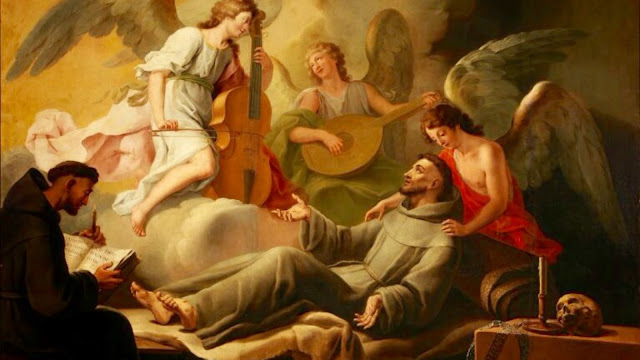
Saint Francis is Comforted by Angels
José Camarón y Bonanat, 1788
Oil on canvas, Museo del Prado, Madrid
José Camarón y Bonanat (1731–1803) was born into a family of artists of Aragonese origin and trained first under his father, the sculptor Nicolás Camarón, and later in Valencia. His skill and reputation grew steadily, leading to his appointment as Academician of Merit at the Real Academia de San Fernando in 1762 and later at the newly founded Academy of San Carlos in Valencia in 1768. He eventually became Director of Painting in 1790 and General Director in 1796. Though he is known for religious paintings, Camarón also produced scenes described by Orellana as “festive compositions of graceful and witty figures,” sometimes leading his work to be mistaken for that of Luis Paret. He left an extensive body of drawings, some preparatory for paintings and others intended as engravings.
In this devotional canvas, Saint Francis is depicted near the end of his life, when his failing eyesight left him unable to write his own testament. At the foot of his bed, a fellow friar records his final words, his posture calm and attentive. Francis, however, is not focused on the earthly task before him. His gaze is lifted upward toward a celestial vision of three angels. Two of the angels—rendered with delicate, luminous features—play instruments to console him: one a violoncello, the other an instrument resembling a round-backed mandolin or early guitar. The third angel gently supports Francis from behind, helping him rise so that he may behold the heavenly visitors more clearly.
Francis’s right hand is extended toward the writing friar, not with a gesture of instruction but one of wonder and longing: an open palm and gently splayed fingers that seem to ask, wordlessly, why his brother cannot see what he sees. A small bedside table in the foreground contains objects traditionally associated with Franciscan contemplation of mortality and penance: an unlit candle, a skull, and a simple rope discipline. The warm, golden-toned background and earthy palette unify the composition, lending the scene an atmosphere of gentle daylight, serenity, and spiritual nearness. Rather than emphasizing dramatic suffering, Camarón presents a moment of tender mystical consolation, portraying the saint not in agony, but at the threshold of peace.


Comments
Post a Comment