
St Francis Virgin Mary and Child
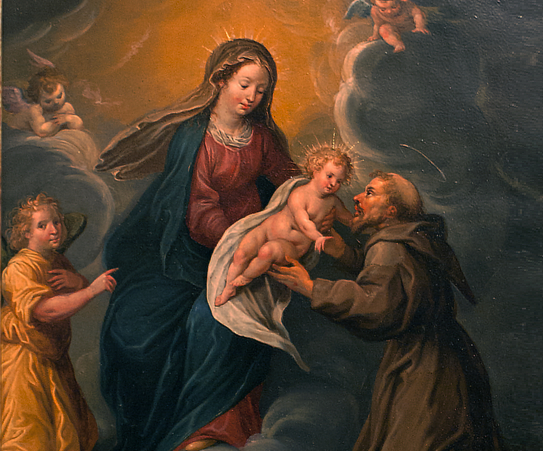
Virgin Mary Hands the Holy Child to Saint Francis – Late 17th / Early 18th century, Italian School, Oil on Copper
This work depicts the apparition of the Blessed Virgin with the Christ Child to Saint Francis of Assisi, framed in a carved and gilt contemporary Tuscan frame. The painting’s iconography stems from a precise excerpt of the rare De cognatione sancti Francisci by Arnaldo of Sarrant (or Samatan), composed in 1365, in which the Saint is represented in ecstatic contemplation of the Virgin, having just received the Child.
Significant is the approach of Saint Francis toward the Christ Child, emphasizing the Poverello as the perfect follower of Christ — an emblematic witness of Counter-Reformation devotion. This representation of an ecstatic saint contemplating the Virgin, immediately after receiving the Child, is unusual and among the last developments of Franciscan iconography, distinct from the more common biographical-miraculous depictions of earlier centuries.
The subject has roots in the Annales Minorum, compiled by Wadding at the start of the 17th century, which describes the Virgin handing the Child to Francis so that he would intercede for sinners and the salvation of the world. Scholars note that this iconography is not derived from Wadding, nor from the Fioretti, nor from their Latin sources, the Actus beati Francisci et sociorum eius. Instead, it originates in a parallel tradition, fixed in the rare De cognatione sancti Francisci and later resumed in the widely circulated Liber conformitatum by Bartolomeo da Pisa (1385–1399), repeatedly reprinted in Italy during the 16th century.
Works like this served as instruments for conveying theological and moral content to the faithful in a clear and understandable visual form, aligning with the post-Tridentine emphasis on didactic religious imagery. The approach of Francis toward the Child underscores his exemplary role as the ideal follower of Christ. At the end of the 16th and the beginning of the 17th centuries, figurative art underwent a profound renewal of content and form: Renaissance humanistic values, classical ideals, and Neoplatonic philosophy inspired deep devotion and a desire to detach from worldly concerns. This glorification of asceticism, inspired by great mystics of the era, shaped the renewed representation of saints’ direct relationships with the divine, replacing mere miraculous episodes with sublime, contemplative visions.
Comments
Post a Comment